Wednesday, December 30, 2009

Newyork Restarents ! new york newyork resorts

Favela in Brooklyn

Don’t worry, it’s NOT what you think! Times are tough, but the Manhattan outskirts are far from being plagued with shantytowns. Miss Favela (“favela” means slum in Portuguese) is a friendly upbeat joint that serves the Brazilian national dish: “feijoada” (pork and black beans stew) amongst other authentic flavors such as “moqueca” (fish stew in coconut milk), “carne seca” (beef jerky) and mandioquinha (fried yucca strips). The atmosphere is like partying on the hills of Rio without the view. The décor is typical of a carioca bar: informal and very colorful. If this place is anything like the French bistro Felix of the same owner Alain Denneulin in Soho, Miss Favela came to stay and conquer the podium as one of Williamsburg’s trendiest spots. Sip the infamous national drink “caipirinha” and join the cheery Brazilian crowd dancing to the live samba music. You might not move as smooth as Brazilian hips, but I guarantee that the cachaca (sugar cane rum) in your caipirinha will definitely improve your sway on the dance floor!
Miss Favela, 57 South 5th Street at Wythe Street, Williamsburg, Brooklyn 718 230-4040.

Unless I have a doctor’s appointment, a business meeting or the occasional play on Broadway, I simply avoid going to Midtown. The rows of drab office skyscrapers separated by wide traffic-heavy roads and sidewalks cramped with crowds – come on… that’s just not inviting. That was until recently. Now I actually see two reasons to endure Midtown steel tower dullness: Monkey Bar and Montenapo.
There’s nothing bland about those two recently opened restaurants.


Monkey Bar
Monkey Bar is the second restaurant venture of Vanity Fair’s editor in chief Graydon Carter. Celebs and high rollers attract rows of paparazzi in front of Waverly Inn, his first restaurant, every single night. When I went to Monkey Bar last Tuesday I saw no one, literally, not a single person at the door. I even thought I was at the wrong address. Hard to believe it’s the hottest new restaurant in town. Easy to see why once you step inside. The interior feels like a charming brasserie. I really tried to get a good look at the all around vintage mural depicting happy monkeys doing human business so that I could describe that fascinating work a little better here, but you’ll have to forgive me. My eyes kept getting distracted looking at Tom Ford instead, his magnetic demeanor sitting in the booth right across from me. As if that wasn’t enough, in comes the chief himself, Mr. Carter and Co., two booths away, sitting across from Donny Deutsch. Once my appetite of celebrity spotting was satisfied I was able to focus on the surprisingly haut cuisine tasting meatloaf, and enjoy my yummy bellini cocktail. Ok, I confess, slightly ogling impeccable T.F., but no worries, without being creepy.

60 E. 54th St, near Park Ave.
212-838-2600

Montenapo
For a genuine powerbroker lunch experience, even if you aren’t one, head to Montenapo, the brand new restaurant named after Via Montenapoleone, the chi-chiest Street in Milan, the Italian capital of fashion. Also italiano is architect Renzo Piano who designed the impressive The New York Times Building, which houses Montenapo. (Yes, some buildings, only a couple of them, manage to break the monotony of the area’s steel towers) The meraviglioso interiors match the delizioso food signed by chef German Lucarelly (Bice). Try the tradizionalissimo risotto milanese, or a branzino after snacking on the softest burrata.

Montenapo at The New York Times Building, 620 8th Ave. (entrance on West 41st Street between 7th & 8th Avenues), 212-764-7663, montenaporestaurant.com


Ah, the new found appeal of Midtown (ok, MoMa I’ll never forget you!)

I felt guilty about not enjoying this dish. Was I not attuned to the subtleties going on? After all, I was at a fish restaurant of a famous chef. Which has been written about extensively. Surely this man REALLY knows his fish. And yet.... why did it seem so boring? The broth, too subtle. The seaweed taste of the marinade, nowhere to be found. The carrots, too al dente to be cut with a spoon, too big to fit in the mouth whole. The fish, just ever so slightly overcooked.

Overall, the dish was... oh dear God... BLAND. There. I said it. Something I'd eat at a spa. Nice. Pretty. Bland. And no spoon to scoop up the broth with. Sigh...


Go figure: the best part of the meal was dessert. Or desserts, in the plural. Chef sent out 3 of them.

First up: 3 cubes of cloud-like zuchini cake topped with lemon cream, and a quenelle of frozen yogurt. Tart and sweet, creamy and soft. Delish. Loved the churros-like fried zuchini garnish.


Another great dessert: cocoa nib cream, chocolate and hazelnut tarte, and, on the side, fior di latte ice cream. Perfection. Especially for gianduja lovers like me. :)


And the third one contained that tired coconut-pineaple combo that every single chef seems to feel obliged to use. Still, it was delicious: a fluffyt ricotta cheesecake topped with cooked and diced pineaple and coconut icecream on the side.
The service was bad beyond words. Can't count how many times I had to wave my hands to try to get someone's attention. I have to cut them some slack - it was, after all, their FIRST day open for lunch. But still, with all those servers you'd think they'd figure out how to communicate with each other! Finished my Ligurian beer and never had anyone ask if I'd like anything else, until I - after trying to flag down 3 guys - finally got one server to come to my table so I could order wine. Geez.

The music really bothered me. Pop-rock. In a formal dining room filled with dressed-up people in their 40s - 60s. The two just didn't go together.


The (tough and cold) bread came with neither oil nor butter. I've seen this done at other places but... come on, how 'bout a little extra-virgin?

Just so this isn't all negative, I did appreciate one nice touch: for now, they're offering 20% off - a "soft opening deal" of sorts. Nice idea.
I figured I should try 2 apps and one main.

As I said before, our bread was only so-so and did not come with oil or butter. I had lunch at The Modern the day before, where both the bread and the butter were exceptional, so I couldn't help feeling let down...

The fluke crudo was nice. Can't think of anything more illuminating to say. I'd add
a pinch of fleur de sel if I had it at the table...

NewYork Hotels 1 new york real estates ! new york city ! newyork hotels ! newyork resorts

Andrew Harper is the famously anonymous hotel inspector who sells his independent reviews in a newsletter called The Hideaway Report.

As Travel + Leisure magazine explains, "In his 30 years of traveling incognito with the mission of reporting the world’s finest hotels, resorts and restaurants in his members-only newsletter Hideaway Report, no one has ever guessed his identity. (...)
The first issue of his advertisement-free Hideaway Report appeared in 1979 and grew by word of mouth. Today, tens of thousands of members pay $195 annually for a basic membership or $400 annually plus a $500 initiation fee to be part of the Premier Class, which offers upgrades and other perks to travelers."

He recently launched an edition on New York, which we were very eager to get our hands on.

The much-respected Harper travels incognito and always pays his own way, so that his opinions can always be counted on as unbiased.

Harper focussed the New York newsletter on the new and noteworthy hotels that everyone's been talking about: The Crosby Hotel, The Plaza and The Pierre, along with a few recently opened restaurants. "I'm glad to report, although battered by the financial meltdown, the city has lost none of its incomparable gift for self-reinvention," Mr. Harper remarked.

He was concerned with making his voice heard amid all the noise: New York hotel reviews are on a million free websites, for example. "So much has been written about the city and so many opinions are widely available," Mr. Harper said, "It forced us to work even harder to try and present some unique viewpoints."


I read the newsletter in full and, to sum it up, Harper loved the Plaza and the Crosby, loved Marea and Corton, yet disliked The Pierre, pictured above, of which he wrote:


The best feature of our moderately sized room was its
side view of Central Park. Decorated with anodyne good
taste, it provided a large desk fitted with the panoply of
electronic gadgetry required by today's business traveler.
(We formed the distinct impression that The Pierre is
primarily targeting the business rather than the leisure
market.) We found it offensively cheeseparing to be
charged an extra $12.95 a night for Internet access, and
from the painfully audible tantrums of a man in the
adjacent room, we gathered that the hotel's fax machines
don't always work flawlessly. It beggars belief that so much
money could have been spent on renovation without
ensuring better soundproofing.
Overall, we found the service to be poorly drilled and
off the mark. We requested a copy of The New York Times
and received a Wall Street Journal instead. And a rather
unappetizing Japanese breakfast (soup, grilled salmon and
rice) was delivered to our room instead of the continental
breakfast we had ordered. It took two more phone calls
to obtain milk and sugar, and the hotel had no cream
cheese for our toasted bagels. In New York!
Since the Manhattan branch of London's Le Caprice
restaurant had yet to open, we went out to dinner. On our
return, we were surprised by the lively Mexican wedding-
party music that the chambermaid had selected for our
evening listening during the turndown service. The Pierre
has a fitness center but no spa, which again ranks it behind
other New York hotels in the same category (especially
the Four Seasons and the Mandarin Oriental). Checking
out the following day, we mentioned the soundproofing
problem to the woman at the front desk, whose only
response was, “New York is a noisy city.”
If The Pierre lacks important amenities and a
well-trained staff, its most serious shortcoming is an
almost total absence of charm.


Ouch! :)

Equitours: Worldwide Horseback Riding Adventures Change World Perceptions of the American Traveler

Equitours: Worldwide Horseback Riding Adventures Change World Perceptions of the American Traveler

If you’re weighing the pleasures of tourism against the discomfort of going abroad at a time when our country seems widely abhorred, you might want to consider savoring a new way of traveling: on horseback

If you’re weighing the pleasures of tourism against the discomfort of going abroad at a time when our country and culture seem widely abhorred, you might want to consider savoring a new way of making an entrance into that picturesque Provence village. Leave the trains, cars and tour buses to others. What really elicits a warm welcome from locals abroad is arriving in town on horseback.

“Anywhere in the world – Iceland, Tierra del Fuego; France, India – local people greet riders in an overwhelmingly open and friendly way; there’s an instant rapport,” says Bayard Fox, the founder of Equitours, the oldest and largest riding vacation company in the United States. “Horses aren’t just a great passport to some of the most beautiful spots in the world, they are a passport to the hearts of people everywhere.”

Fox, who, with his wife, Mel, has spent the better part of twenty-five years taking Americans to every part of the globe on equestrian vacations, is no stranger to chilly foreign relations. A former CIA operative from the Cold War era, he’s spent years living in Paris, riding with nomadic tribes in Iran, and posing as a big game hunter in Central Africa, all to gather information for the U.S. during the 50s and 60s. His knowledge of foreign cultures is enormous; and his experience has been invaluable in carefully choosing the world’s bes

amaica's underwater wonders

amaica's underwater wonders

Over the years many songwriters have referred to the beauty of this green pearl in the string of Caribbean islands, and today it is known throughout the world for its lush vegetation, reggae music, rum and coffee. One of the most overlooked attractions is, however, that part of the island that lies below the surface of the ocean that surrounds it. Divers typically do not think of Jamaica as a prime diving destination, except for those who have explored its reefs and have found it to be the best destination of all. Where else can you do a breathtaking wall dive in the morning, enjoy the sea life on a shallow reef at noon, and have plenty of time left in the afternoon to go river rafting, horseback riding, play golf, visit a great house or indulge in any manner of activities. Jamaica as one of the largest islands in the Caribbean has many excellent diving and snorkeling sites: shallow and deep, reefs and walls, wrecks and caverns, home to all manner of sea life: spectacular coral, exotic sponges, spiny lobsters, moray eels, sea turtles and multitudes of colorful fish, big and small. Below we have selected by region some of the unique diving opportunities available to you based on your level of experience. All dives offered by commercial operators in Jamaica are guided dives. The dive guides must have, according to regulations, at least a dive master certificate from an internationally recognized association and be licensed by the Jamaica Tourist Board. Although this limits your freedom to dive wherever you like, this regulation increases the safety and fun of diving in an unfamiliar area. The dive classifications employed below were assigned based on the following principles: Novice divers: Persons who are recently certified, or who have done only a limited number of dives with considerable gaps in between; this could include divers with as many as 20 dives. Dives in this category will tend to be less than 60 ft (18 m) or will not require advanced diving skills. Intermediate divers: Persons who have been diving on a regular basis but lack further training beyond certification, also those with advanced training who have not been diving for the past several months. The environment of this category of dive necessitates greater experience. Advanced divers: Persons with training beyond the open water diver certification that have been diving regularly in the last several months. This requirement will apply to most sites deeper than 80 ft (24 m) because those dives require a mastery of buoyancy and a thorough knowledge of the dive tables. These dives may also be accessible to the less experienced diver after a couple of refresher dives.

MONTEGO BAY Rose Hall Reef Depth: 20-45 ft (7-14 m) Class: Novice Named for the famous great house that overlooks the sea just a couple of miles east of Montego Bay, this shallow reef is teaming with marine life. At this location you'll discover "Fairy Castle", a massive colony of pillar coral, and "Fairy Bridge", a coral formation that connects two sections of reef over a sandy "river". The reef forms an intricate system of tunnels that are home to squirrelfish, goatfish, porcupinefish, bar jacks and grunts.

The Spanish Anchor Depth: 50-90 ft (15-28 m) Class: Intermediate Located on the west side of the marine park, the shallow reef drops to a sandy bottom at 50 ft. The site derives its name from the large anchor, undated but of Spanish origin, that rests on the sandy bottom. Within the reef wall one can explore tunnels and caverns with abundant sponge colonies. Sightings of eagle rays are quite common here, and in the deeper water large mutton snappers- and sometimes a docile nurse sharkmay pass by.

Widowmaker's Cave Depth: 40-80 ft (12-24 m) Class: Advanced A deep dive along a wall with a vertical, narrow crack which forms the entrance to Widowmaker's Cave. Inside the tunnel leading to the cave, there is wire coral with, in the beam of your dive light, red polyps, and the walls are covered with multicolored sponges. On this dive you'll likely encounter schools of silvery blue bogas, glassy sweepers, schoolmaster snappers, balloonfish, trumpetfish, hamlets, wrasses and parrotfish.

NEGRIL The Throne Room Depth: 40-70 ft (12-21 m) Class: Novice The entrance to the Throne Room, a fairly wide but low cavern, is a crack in the reef about 25 feet long and 8 feet wide. The walls on the inside are covered with colorful sponges and on the bottom near to the exit you can see a large orange elephant ear sponge for which the site is named. Ceros, cruising along over the sandy bottom, are a common sight, as are small groups of yellow tail snapper.

The Caves Depth: 40-70 ft (12-21 m) Class: Intermediate This site is named for the two caverns, one small and one slightly larger, with a narrow tunnel connecting the two. You can find a variety of sponges here along with soft gorgonians. On the sand flat you will see the usual occupants: furry sea cucumbers, stingrays, jacks and some lane snappers.

Kingfish Point Depth: 80-90 ft (24-27 m) Class: Advanced Among the elephant ear sponges and yellow tube sponges, you may

Ecotourism 2

Ecotourism

Coined by Héctor Ceballos-Lascuràin in 1983 the term Ecotourism was used to describe nature centric travel to relatively undisturbed areas with an emphasis on education. Today ecotourism consists of cultural tourism, nature tourism, leisure tourism and a good dose of adventure. Sound ecotourism involves travel to natural destinations, minimizes impact, builds environmental awareness, provides direct financial benefits for conservation, provides financial benefits and empowerment for local people, respects local culture, and supports human rights and not exploitation. It is an enlightening, participatory travel experience to environments, both natural and cultural which produces viable economic opportunities for the tourism industry and host communities, and makes the use of these resources through conservation beneficial to all tourism role players.


Global Ecotourism

According to the World Tourism Organisation Ecotourism is the fastest growing market within the ever expanding global tourism industry. Eco-travel is a serious player within the global tourism market and is fast becoming the preferred option in vacationing. We are a society trademarked by a heightened environmental consciousness not known in past eras. This combined with easy accessibility to exotic locations is what has drawn so many to eco-travel. Countries have begun to promote their natural resources, unique locals and tourism facilities in a bid to capture the interest of intrepid eco-travellers. Businesses are constructing camps and lodges and trails and tours are being designed to facilitate the wants and needs of the eco-tourists.


Ecotourism in Africa

Africa is synonymous with the concept of ecotourism, its multitude of game parks and reserves conserve some of the world's most magnificent creatures. The bird life throughout the continent is remarkable, natural wonders are scattered throughout the continent and the cultures and traditions of past eras mystically intertwine with modern day. Each country on this diverse continent offers its own unique appeal to eco-travellers and no eco-traveller would be complete without a trip to Africa.


A Jewel at the Tip of Africa

When the path of tourism began to diverge to ecotourism; nature, heritage and recreational destinations became more important than before and South Africa is a haven for these three cornerstones of eco-tourism. Lying at the very tip of Africa, South Africa is home to some of the most magnificent vistas, sunsets and natural resources one could hope to encounter. It is near impossible to separate SA from a nature experience and the strongest

Best Hotels are Found Here

Best Hotels are Found Here

Best Hotels are Found Here

Need help? Need a place to stay? Try Hotelslocator.com

Whether you're on your vacation, in for a conference in the city, or just visiting, nothing beats going back to a nice hotel after the day is done. A good night's sleep and nice stay can recharge and invigorate you, getting you ready for the next day.

Standard hotels usually have basic accommodation like a room with a bed, a cupboard, a small table. Washstands have been largely replaced by rooms with en-suite bathrooms. Other features found may be a TV, a telephone and an alarm clock. Food and drink may be supplied in a small refrigerator which is usually referred to as "mini-bar", containing snacks, drinks and tea and coffee making facilities like cups, spoons, an electric kettle and sachets containing instant coffee, tea bags, sugar, and creamer or milk. Aside from these, food and drinks may also be ordered through room service, some hotels even offer specialty cuisine which they are famous for.

However, in Japan the capsule hotel supplies minimal facilities and room space. The cost and quality of hotels are usually indicative of the range and type of services available. Due to the enormous increase in tourism worldwide during the last decades of the 20th century, standards, especially those of smaller establishments, have improved considerably. For the sake of greater comparability, rating systems have been introduced, with the one to five stars classification being most common.

But sometimes hotel availability can be a problem. This is where a hotel directory comes in handy. A hotel directory, either on the Internet or in a magazine type publication, is a list of all hotels/motels/places of lodging in a certain area. Typically it also includes reviews

A Complete India Travel Guide Launched

A Complete India Travel Guide Launched

Your wait is finally over. A complete Travel Guide, www.travelgoindia.com that focuses completely on India has been launched. The days of scratching about for information on India before you embark on a tour of this beautiful country is passé. Learn more about the beauty of this enchanting land from this exhaustively informative website www.travelgoindia.com. This travel guide has quite a few useful tools that enable it to become a traveler’s best friend.

Are you ready to pack your bag but not very sure about your destination? At TravelGoIndia.com you will get to know about some tourist locations, whose existence you were never aware of. No wonder, this is by far the best India Travel Guide that you will find in the Internet. Rich in information, this exclusively India centric travel guide is surely destined to become a tourist’s best pal.

TravelGoIndia.com is conceived to provide travelers with enough information on travel so that it becomes easier for them to take decisions. The website enables you to book hotels in more than 150 Indian cities. You also have the choice to book a luxury hotel or a budget hotel. One added advantage that this complete India Travel Guide has is its ability to book hotels real time through partners and give instant confirmation facility. It has more than 500 hotels of all categories throughout India in its database. You can, therefore, be pretty sure of getting a hotel room anywhere in the country.

computer softwares

computer softwares

  1. Simtel: Free Download of Computer Software, Games, Tools and ...

    Simtel is one of the largest software download sites, featuring free downloads of shareware, freeware, trialware and demo software, games, ...
    www.simtel.net/ - 92k - Cached - Similar pages -
  2. Free Software Downloads and Reviews - Download.com

    Find the software you're looking for at Download.com, the most comprehensive source for ... Because what good is a new computer without the right software? ...
    download.cnet.com/ - 64k - Cached - Similar pages -
  3. Computer software - Wikipedia, the free encyclopedia

    Computer software, or just software is a general term used to describe a collection of computer programs, procedures and documentation that perform some ...
    en.wikipedia.org/wiki/Software - 93k - Cached - Similar pages -
  4. Music Software - Computer Music Resources - Shareware Music Machine

    Your music software download and computer music resource site with a huge collection of well over 6000 music software programs listed.
    www.hitsquad.com/smm/ - 23k - Cached - Similar pages -
  5. Computer Software Packages,Software Package Exporters,Business ...

    Directory of exporters and suppliers of computer software packages, software package, business software packages, wholesale computer softwares and software ...
    dir.indiamart.com/indianexporters/com_soft.html - 80k - Cached - Similar pages -
  6. Jumbo: Free & Shareware MP3 files, Games, Screen Savers & Computer ...

    Jumbo is the source for free MP3 files, games, desktop themes, screen savers and the latest computer software.
    www.jumbo.com/ - 80k - Cached - Similar pages -
  7. GoLoads Free Downloads

    Goloads.com features thousands of free software downloads, freeware and shareware softwares fully reviewed. Find and download easily online free screensaver ...
    www.goloads.com/ - 14k - Cached - Similar pages -
  8. Amazon.com Software: Computer & video games, business, accounting ...

    Online shopping for computer & video games, business & office productivity software, software from Microsoft, Apple, Adobe & more; accounting, antivirus, ...
    www.amazon.com/software-business-education-finance-childrens/b?ie=UTF8&node=229534 - 172k - Cached - Similar pages -
  9. SME Toolkit India - Computer Softwares

    Computer Softwares. To display all of the items in a folder, click the [ + ] sign. To hide the items in a folder, click the [ - ] sign. ...
    india.smetoolkit.org/india/en/category/2702/Computer-Softwares- - 38k - Cached - Similar pages -
  10. Axiontech.com-Dallas' Discount Computer Store for Hardware ...

    Best buy price Computer Parts, PC Components, notebook computer, computer desktop best ... Printers, Scanners & Faxes, Processors, Softwares, Sound Cards ...
    www.axiontech.com/ - 72k - Cached - Similar pages -
Searches related to: computer softwares
freeware computer softwarecomputer software utilitiescomputer flash drivescomputer antivirus software
convert dvd computercomputer windows xppocket pc computercomputer keyboard software

computer hardware

Personal computer hardware

From Wikipedia, the free encyclopedia

(Redirected from Computer hardware)
Jump to: navigation, search
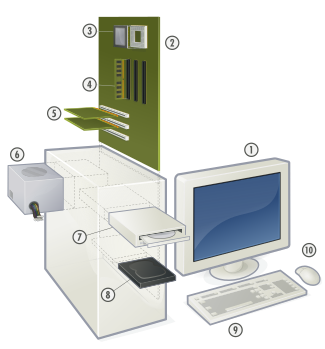
Hardware of Personal Computer .
1. Monitor
2. Motherboard
3. CPU
4. RAM Memory
5. Expansion card
6. Power Supply
7. CD-ROM Drive
8. Hard Disk
9. Keyboard
10. Mouse
Inside a custom computer.

A personal computer is made up of multiple physical components of computer hardware, upon which can be installed an operating system and a multitude of software to perform the operator's desired functions.

Contents

[hide]
  • 1 Typical PC hardware
    • 1.1 Motherboard
    • 1.2 Power supply
    • 1.3 Video display controller
    • 1.4 Removable media devices
    • 1.5 Internal storage
    • 1.6 Sound card
    • 1.7 Networking
    • 1.8 Other peripherals
      • 1.8.1 Input
      • 1.8.2 Output
  • 2 See also
  • 3 External links

[edit] Typical PC hardware

Though a PC comes in many different form factors, a typical personal computer consists of a case or chassis in a tower shape (desktop) and the following parts:

[edit] Motherboard

The motherboard is the "body"[citation needed] of the computer. Components directly attached to the motherboard include:

  • The central processing unit (CPU) performs most of the calculations which enable a computer to function, and is sometimes referred to as the "brain" of the computer. It is usually cooled by a heat sink and fan.
  • The chipset mediates communication between the CPU and the other components of the system, including main memory.
  • RAM Stores all running processes (applications) and the current running OS. RAM Stands for Random Access Memory
  • The BIOS includes boot firmware and power management. The Basic Input Output System tasks are handled by operating system drivers.
  • Internal Buses connect the CPU to various internal components and to expansion cards for graphics and sound.
    • Current
      • The northbridge memory controller, for RAM and PCI Express
        • PCI Express, for graphics cards
      • PCI, for other expansion cards
      • SATA, for disk drives
    • Obsolete
      • ATA (superseded by SATA)
      • AGP (superseded by PCI Express)
      • VLB VESA Local Bus (superseded by AGP)
      • ISA (expansion card slot format obsolete in PCs, but still used in industrial computers)
  • External Bus Controllers support ports for external peripherals. These ports may be controlled directly by the southbridge I/O controller or based on expansion cards attached to the motherboard through the PCI bus.
    • USB
    • FireWire
    • eSATA

[edit] Power supply

Includes power cord, switch, and cooling fan. Supplies power at appropriate voltages to the motherboard and internal disk drives.

[edit] Video display controller

Produces the output for the visual display unit. This will either be built into the motherboard or attached in its own separate slot (PCI, PCI-E, PCI-E 2.0, or AGP), in the form of a graphics card.

[edit] Removable media devices

  • CD (compact disc) - the most common type of removable media, suitable for music and data.
    • CD-ROM Drive - a device used for reading data from a CD.
    • CD Writer - a device used for both reading and writing data to and from a CD.
  • DVD (digital versatile disc) - a popular type of removable media that is the same dimensions as a CD but stores up to 12 times as much information. It is the most common way of transferring digital video, and is popular for data storage.
    • DVD-ROM Drive - a device used for reading data from a DVD.
    • DVD Writer - a device used for both reading and writing data to and from a DVD.
    • DVD-RAM Drive - a device used for rapid writing and reading of data from a special type of DVD.
  • Blu-ray Disc - a high-density optical disc format for data and high-definition video. Can store 70 times as much information as a CD.
    • BD-ROM Drive - a device used for reading data from a Blu-ray disc.
    • BD Writer - a device used for both reading and writing data to and from a Blu-ray disc.
  • HD DVD - a discontinued competitor to the Blu-ray format.
  • Floppy disk - an outdated storage device consisting of a thin disk of a flexible magnetic storage medium. Used today mainly for loading RAID drivers.
  • Zip drive - an outdated medium-capacity removable disk storage system, first introduced by Iomega in 1994.
  • USB flash drive - a flash memory data storage device integrated with a USB interface, typically small, lightweight, removable, and rewritable. Capacities vary, from hundreds of megabytes (in the same ballpark as CDs) to tens of gigabytes (surpassing, at great expense, Blu-ray discs).
  • Tape drive - a device that reads and writes data on a magnetic tape, used for long term storage and backups.

[edit] Internal storage

Hardware that keeps data inside the computer for later use and remains persistent even when the computer has no power.

  • Hard disk - for medium-term storage of data.
  • Solid-state drive - a device similar to hard disk, but containing no moving parts and stores data in a digital format.
  • RAID array controller - a device to manage several internal or external hard disks and optionally some peripherals in order to achieve performance or reliability improvement in what is called a RAID array.

[edit] Sound card

Enables the computer to output sound to audio devices, as well as accept input from a microphone. Most modern computers have sound cards built-in to the motherboard, though it is common for a user to install a separate sound card as an upgrade. Most sound cards, either built-in or added, have surround sound capabilities.

[edit] Networking

Connects the computer to the Internet and/or other computers.

  • Modem - for dial-up connections or sending digital faxes. (outdated)
  • Network card - for DSL/Cable internet, and/or connecting to other computers, using IEEE 802.3 standards.
  • Direct Cable Connection - Use of a null modem, connecting two computers together using their serial ports or a Laplink Cable, connecting two computers together with their parallel ports.

[edit] Other peripherals

In addition, hardware devices can include external components of a computer system. The following are either standard or very common.

Wheel Mouse

Includes various input and output devices, usually external to the computer system.

[edit] Input

  • Text input devices
    • Keyboard - a device to input text and characters by depressing buttons (referred to as keys), similar to a typewriter. The most common English-language key layout is the QWERTY layout.
  • Pointing devices
    • Mouse - a pointing device that detects two dimensional motion relative to its supporting surface.
    • Optical Mouse - a newer technology that uses lasers, or more commonly LEDs to track the surface under the mouse to determine motion of the mouse, to be translated into mouse movements on the screen.
    • Trackball - a pointing device consisting of an exposed protruding ball housed in a socket that detects rotation about two axes.
  • Gaming devices
    • Joystick - a general control device that consists of a handheld stick that pivots around one end, to detect angles in two or three dimensions.
    • Gamepad - a general handheld game controller that relies on the digits (especially thumbs) to provide input.
    • Game controller - a specific type of controller specialized for certain gaming purposes.
  • Image, Video input devices
    • Image scanner - a device that provides input by analyzing images, printed text, handwriting, or an object.
    • Webcam - a low resolution video camera used to provide visual input that can be easily transferred over the internet.
  • Audio input devices
    • Microphone - an acoustic sensor that provides input by converting sound into electrical signals.
    • Mic - Converting an autio signal into electrical signal

Usa Realestate

Mercedes Homes- USA
www.MercedesHomes.com Investment and Vacation Homes in the US. Save Thousands Now!
Realestate
99acres.com Search Homes, Flats, Shops, Villas, Land, Office Space Online for Free!
Did you mean: real estates usa
Search Results
Real Estate Listings, Homes for Sale and Rental Property Listings ...
REALTOR.com® puts real estate listings for millions of homes for sale at your fingertips in regions across the United States and Canada. In the U.S. we ...
www.realtor.com/ - 73k - Cached - Similar pages
Luxury Homes for Sale - Luxury Real Estate
Listing Properties With Us · Real Estate Web sites · Print Services .... the Who's Who In Luxury Real Estate brand continues to set the standard for ...
Search - Europe - The Jewel of Tennessee Estate - Australia
www.luxuryrealestate.com/ - 59k - Cached - Similar pages
Real Estates USA -
Results 1 - 15 of 29 found in Real Estates - USA: The Closing Company. The closing company is a full service agency that provides title search, closing, ...
www.elib.org/dire/166/20.php - 21k - Cached - Similar pages
Real Estate Listings - Real Estate Agents | CENTURY 21
GLOBAL REAL ESTATE. CENTURY 21 has offices and real estate listings in over 60 countries and territories world- wide. See where you can find us. ...
www.century21.com/ - 76k - Cached - Similar pages
Real Estate for Sale, Government Surplus and Foreclosures: USA.gov
9 Mar 2009 ... USA.gov Sales and Auctions: Government Surplus & Foreclosed Real Estate for Sale -- Buy real estate that the government has seized or no ...
www.usa.gov/shopping/realestate/realestate.shtml - 26k - Cached - Similar pages
Real Estate | Homes for Sale | Houses for Sale | MLS Listings ...
Find homes for sale, real estate listings, home prices, new homes, real estate agents and mortgage ... Real Estate Agents: Partner with us. 800-RealEstate ...
www.realestate.com/ - 54k - Cached - Similar pages
GE Real Estate
GE Real Estate, a unit of GE Commercial Finance, is one of the world's leading resources for commercial real estate capital. Headquartered in Norwalk ...
usa.gerealestate.com/ - 16k - Cached - Similar pages
Real Estate Agents in the US
Real Estate Agents in the United States. ... You are here: Home · Real Estate USA ... Real Estate company established since 1988 ...
www.ibsteam.net/real-estate-usa - 24k - Cached - Similar pages
Real Estate USA - Real Estate - Ansearch.com Directory
USA Real Estate License School. Courses and self study prorgrams for all 50 US states. Pass-or-don't-pay, 100% money back guarantee. ...
stocks.anzwers.com.au/Real_Estate/Real_Estate_USA - 11k - Cached - Similar pages
ERA Real Estate - Properties for Sale
ERA Real Estate - Answers to frequently asked questions about buying, selling, ... Value of a Pre-Approval Home Purchase Get Pre-Approved Contact Us ...
www.era.com/ - 45k - Cached - Similar pages
USA Red Hot Real Estate
Call Mike 001-702-575-2090 & Profit
Only 0.69 Cents A SQ. Foot! Unreal.
www.BuyArizonaDirt.com
USA Income Property -
Retail, Apartment Buildings, Office
$1 Million Minimum - No Maximum
USAPropertyConnect.com
Worldwide Real Estate
Simply buy and sell international
Real Estate and properties.
www.planetproperty.de/en/
Usa Realestate US
Homes in US 50%+ Below Market Value
Search Free and Save a Fortune Now!
www.ZipRealty.com
Atlanta USA Real Estate
Real Estate For Sale in Atlanta USA
Homes, Business, Foreclosure Deals
www.MilfordJosephs.com
Buy & Sell USA 2009
Advertise and view America property
& real estate here for free!
www.4321.co.il

BARRACUDA DIVING

BARRACUDA DIVING INDIA

BARRACUDA DIVING INDIA began operations in 1993 to promote the sport of recreational diving in India. We are the first and only PADI 5 Star Dive Resort in the entire Indian sub-continent. Our membership, held since 1997, recognizes the highest standards of diver education, staff training, safety, equipment and dive services and denotes a quality control assurance to divers worldwide. The Barracuda team have proudly received three PADI 'Awards of Excellence' for outstanding dedication to diver safety, education and environmental conservation.

Owners Venkatesh Charloo (India) and Karen Gregory (U.K.) are both highly qualified PADI IDC Staff Instructors with extensive diving and teaching experience in Hong Kong, Philippines, Australia, New Zealand, Malaysia, Indonesia, Thailand, Maldives, Andaman and Lakshadweep Islands. With 14 years of teaching, diving and travel in India we look forward to sharing our incomparable passion for the knowledge and beauty of our amazing underwater worldPlanning your perfect dive holiday just became easy. We have teamed up with some of the worlds leading dive operators to offer select, all inclusive diving/accommodation packages for small groups and individuals. Choose from exotic destinations including Andaman Islands, Bali, Maldives, Manado, Indonesia and Sipadan, Malaysia.Are you ready to change your life? Love adventure and travel, meeting new friends and facing new challenges? Become a PADI Scuba Diving Instructor or Divemaster with our personalized professional training internships. Great discounts on courses, equipment, travel, accommodation and study materials. Job placement services available.Yes, learning to scuba dive is fun and easy! Experience your first exhilarating breath underwater with PADI Discover Scuba Diving. Weekend free? Get certified with PADI Scuba Diver. Start now with PADI e-learning, the PADI Open Water Course is just a CLICK away.

Read more....
Fun for all the family, join us aboard our fast and comfortable dive boat for morning scuba diving and snorkelling trips to Grande Island, Goa. Explore calm, sandy bays, pretty coral fields, exciting shipwrecks and the abundance of colorful aquatic life in the sparkling warm waters of the Arabian Sea.

scuba diving 2

scuba diving 2

Diving masks and diving helmets and fullface masks solve this problem by creating an air space in front of the diver's eyes.[1] The refraction error created by the water is mostly corrected as the light travels from water to air through a flat lens, except that objects appear approximately 34% bigger and 25% closer in salt water than they actually are. Therefore total field-of-view is significantly reduced and eye-hand coordination must be adjusted.
(This affects underwater photography: a camera seeing through a flat window in its casing is affected the same as its user's eye seeing through a flat mask window, and so its user must focus for the apparent distance to target, not for the real distance.)
Divers who need corrective lenses to see clearly outside the water would normally need the same prescription while wearing a mask. Generic and custom corrective lenses are available for some two-window masks. Custom lenses can be bonded onto masks that have a single front window.
A "double-dome mask" has curved windows in an attempt to cure these faults, but this causes a refraction problem of its own.
On rare occasions, commando frogmen use special contact lenses instead, to see underwater without the large glass surface of a diving mask, which can reflect light and give away the frogman's position.
As a diver changes depth, he must periodically exhale through his nose to equalize the internal pressure of the mask with that of the surrounding water. Swimming goggles which only cover the eyes do not allow for equalization and thus are not suitable for diving.
[edit]Controlling buoyancy underwater


Diver under the Salt Pier in Bonaire.
To dive safely, divers need to be able to control their rate of descent and ascent in the water.[2] Ignoring other forces such as water currents and swimming, the diver's overall buoyancy determines whether he ascends or descends. Equipment such as the diving weighting systems, diving suits (Wet, Dry & Semi-dry suits are used depending on the water temperature) and buoyancy compensators can be used to adjust the overall buoyancy.[1] When divers want to remain at constant depth, they try to achieve neutral buoyancy. This minimizes gas consumption caused by swimming to maintain depth.
The downward force on the diver is the weight of the diver and his equipment minus the weight of the same volume of the liquid that he is immersed in; if the result is negative, that force is upwards. Diving weighting systems can be used to reduce the diver's weight and cause an ascent in an emergency. Diving suits, mostly being made of compressible materials, shrink as the diver descends, and expand as the diver ascends, creating unwanted buoyancy changes. The diver can inject air into some diving suits to counteract this effect and squeeze. Buoyancy compensators allow easy and fine adjustments in the diver's overall volume and therefore buoyancy. For open circuit divers, changes in the diver's lung volume can be used to adjust buoyancy.
[edit]Avoiding losing body heat
Main article: Diving suit
Water conducts heat from the diver 25 times[10] better than air, which can lead to hypothermia even in mild water temperatures.[2] Symptoms of hypothermia include impaired judgment and dexterity[11], which can quickly become deadly in an aquatic environment. In all but the warmest waters, divers need the thermal insulation provided by wetsuits or drysuits.[1]
In the case of a wetsuit, the suit is designed to minimize heat loss. Wetsuits are generally made of neoprene that has small gas cells, generally nitrogen, trapped in it during the manufacturing process. The poor thermal conductivity of this expanded cell neoprene means that wetsuits reduce loss of body heat by conduction to the surrounding water. The neoprene in this case acts as an insulator.
The second way in which wetsuits reduce heat loss is to trap a thin layer of water between the diver's skin and the insulating suit itself. Body heat then heats the trapped water. Provided the wetsuit is reasonably well-sealed at all openings (neck, wrists, legs), this reduces water flow over the surface of the skin, reducing loss of body heat by convection, and therefore keeps the diver warm (this is the principle employed in the use of a "Semi-Dry")


Spring suit and steamer
In the case of a drysuit, it does exactly that: keeps a diver dry. The suit is sealed so that frigid water cannot penetrate the suit. Drysuit undergarments are often worn under a drysuit as well, and help to keep layers of air inside the suit for better thermal insulation. Some divers carry an extra gas bottle dedicated to filling the dry suit. Usually this bottle contains argon gas, because of its better insulation as compared with air.[12]
Drysuits fall into two main categories neoprene and membrane; both systems have their good and bad points but generally their thermal properties can be reduced to:
Membrane: usually a trilaminate construction; owing to the thinness of the material (around 1 mm), these require an undersuit, usually of high insulation value if diving in cooler water.
Neoprene: a similar construction to wetsuits; these are often considerably thicker (7-8 mm) and have sufficient insulation to allow a lighter-weight undersuit (or none at all); however on deeper dives the neoprene can compress to as little as 2 mm thus losing a proportion of their insulation. Compressed or crushed neoprene may also be used (where the neoprene is pre-compressed to 2-3 mm) which avoids the variation of insulating properties with depth.
[edit]Avoiding skin cuts and grazes
Diving suits also help prevent the diver's skin being damaged by rough or sharp underwater objects, marine animals or coral.
[edit]Diving longer and deeper safely
There are a number of techniques to increase the diver's ability to dive deeper and longer:
Technical diving - diving deeper than 40 metres (130 ft), using mixed gases, and/or entering overhead environments (caves or wrecks)
surface supplied diving - use of umbilical gas supply and diving helmets.[1]
saturation diving - long-term use of underwater habitats under pressure and a gradual release of pressure over several days in a decompression chamber at the end of a dive.[1]
[edit]Being mobile underwater
The diver needs to be mobile underwater. Streamlining dive gear will reduce drag and improve mobility. Personal mobility is enhanced by swimfins and Diver Propulsion Vehicles. Other equipment to improve mobility includes diving bells and diving shots.
scuba diving does not have a centralized certifying or regulatory agency, and is mostly self regulated. There are, however, several large diving organizations that train and certify divers and dive instructors, and many diving related sales and rental outlets require proof of diver certification from one of these organizations prior to selling or renting certain diving products or services.
The largest international certification agencies that are currently recognized by most diving outlets for diver certification include:
American Canadian Underwater Certifications (ACUC) (formerly Association of Canadian Underwater Councils) - originated in Canada in 1969 and expanded internationally in 1984
British Sub Aqua Club (BSAC) - based in the United Kingdom, founded in 1953 and is the largest dive club in the world
European Committee of Professional Diving Instructors (CEDIP) based in Europe since 1992 (see Cedip on French Wiki pages)
Confédération Mondiale des Activités Subaquatiques (CMAS), the World Underwater Federation
National Association of Underwater Instructors (NAUI) - based in the United States
Professional Diving Instructors Corporation (PDIC) - based in the United States
Professional Association of Diving Instructors (PADI) - based in the United States, largest recreational dive training and certification organization in the world
Scottish Sub Aqua Club (SSAC or ScotSAC) the National Governing Body for the sport of diving in Scotland.
International Training SDI, TDI & ERDi -based in the United States, TDI is the world's largest technical diving agency, SDI is the recreational division focusing on new methods and online courses, and ERDi is the public safety component.
Scuba Schools International (SSI) - based in the United States with 35 Regional Centers and Area Offices around the globe.
YMCA scuba - based in the U.S., part of Young Men's Christian Association (YMCA), a Christian related organization (open to all faiths, ages and genders despite the historic name)

Scuba diving

Scuba (originally an acronym for Self Contained Underwater Breathing Apparatus) diving is swimming underwater, or taking part in another activity, while using a scuba set.[1] By carrying a source of breathing gas (usually compressed air),[2] the scuba diver is able to stay underwater longer than with the simple breath-holding techniques used in snorkeling and free-diving, and is not hindered by air lines to a remote air source. The scuba diver typically swims underwater by using fins attached to the feet. However, some divers also move around with the assistance of a DPV (diver propulsion vehicle), commonly called a "scooter", or by using surface-tethered devices called sleds pulled by a boat.
For the history of diving, see timeline of underwater technology.
Contents [hide]
1 History
2 Etymology
3 Types of diving
4 Physiological issues
4.1 Breathing underwater
4.2 Open-circuit
4.3 Rebreather
4.4 Gas mixtures
4.5 Injuries due to changes in air pressure
4.6 Effects of breathing high pressure gas
4.6.1 Decompression sickness
4.6.2 Nitrogen narcosis
4.6.3 Oxygen toxicity
4.7 Refraction and underwater vision
4.8 Controlling buoyancy underwater
4.9 Avoiding losing body heat
4.10 Avoiding skin cuts and grazes
4.11 Diving longer and deeper safely
4.12 Being mobile underwater
5 Scuba dive training and certification agencies
6 See also
7 Reference list
8 Further reading
9 External links
History

Scuba today typically refers to the in-line open-circuit equipment, developed by Emile Gagnan and Jacques-Yves Cousteau, in which compressed gas (usually air) is inhaled from a tank and then exhaled into the water. However, rebreathers (both semi-closed circuit and closed circuit) are also self-contained systems (as opposed to surface-supplied systems) and are therefore classified as scuba.
[edit]Etymology

The term SCUBA (an acronym for Self-Contained Underwater Breathing Apparatus) arose during World War II, and originally referred to United States combat frogmen's oxygen rebreathers, developed by Dr. Christian Lambertsen for underwater warfare.[2][3][4].
The word SCUBA began as an acronym, but it is now usually thought of as a regular word—scuba. It has become acceptable to refer to "scuba equipment" or "scuba apparatus"—examples of the linguistic RAS syndrome. It has been adapted into the Welsh language as "sgwba".
[edit]Types of diving


Divemaster ready to dive Shark and Yolanda reefs at Rās Muhammad, Sharm el-Sheikh.
Scuba diving is still evolving, but general classifications have grown to describe various diving activities. These classifications include:
Commercial diving
Military diving
Naval diving
Police diving
Professional diving
Recreational diving
Rescue and recovery diving
Scientific diving
Technical diving
Cave diving
Cavern diving
Deep diving
Ice diving
Wreck diving
Reasons for diving may include:
Breathing underwater


The diver down flag - Designates a diver is in the water
For more information, see Diving regulator.
Water normally contains dissolved oxygen from which fish and other aquatic animals extract all their required oxygen as the water flows past their gills. Humans lack gills and do not otherwise have the capacity to breathe underwater unaided by external devices.[2]
Early diving experimenters quickly discovered it is not enough simply to supply air in order to breathe comfortably underwater. As one descends, in addition to the normal atmospheric pressure, water exerts increasing pressure on the chest and lungs — approximately 1 bar or 14.7 psi for every 33 feet or 10 meters of depth — so the pressure of the inhaled breath must almost exactly counter the surrounding or ambient pressure to inflate the lungs. It generally becomes difficult to breathe through a tube past three feet under the water.[2]
By always providing the breathing gas at ambient pressure, modern demand valve regulators ensure the diver can inhale and exhale naturally and virtually effortlessly, regardless of depth.
Because the diver's nose and eyes are covered by a diving mask; the diver cannot breathe in through the nose, except when wearing a full face diving mask. However, inhaling from a regulator's mouthpiece becomes second nature very quickly.

Hotels and Motels

A former British colony, Central American Belize is very much Caribbean in spirit. Forty per cent of this English-speaking paradise is protected park and nature reserve land. Enthralling Maya ruins await amid rainforest canopies. Awe-inspiring scuba diving and eco-adventures are on offer along the world's second-longest barrier reef. The 1000-foot-diameter Blue Hole is so big and so blue that it can be seen from outer space. To make the most of your visit, consider domestic flights within
hotels in popular destinations
United States & Canada
Atlanta hotels
Atlantic City hotels
Boston hotels
Chicago hotels
Dallas hotels
Disneyland - Anaheim hotels
Disneyworld - Orlando hotels
Honolulu hotels
Key West hotels
Las Vegas hotels
Los Angeles hotels
Maui hotels
Miami hotels
New Orleans hotels
New York City hotels
Philadelphia hotels
Phoenix hotels
San Diego hotels
San Francisco hotels
Seattle hotels
Toronto hotels
Vancouver hotels
Washington DC hotels
Europe
Amsterdam hotels
Barcelona hotels
Berlin hotels
Dublin hotels
Florence hotels
Frankfurt hotels
London hotels
Madrid hotels
Munich hotels
Paris hotels
Rome hotels
Venice hotels
Caribbean/Mexico
Cancun hotels
Dominican Republic hotels
Jamaica hotels
Mexico City hotels
Playa del Carmen hotels
Puerto Plata hotels
Puerto Rico hotels
Punta Cana hotels
Asia/Pacific & Australia
Bali hotels
Bangkok hotels
Beijing hotels
Hong Kong hotels
Singapore hotels
Sydney hotels
Tokyo hotels
Africa/Middle East
Dubai hotels
Sharm El-Sheikh hotels
Central/South America
Buenos Aires hotels

TripAdvisor SmartDeals are the best deals on the best hotels in Belize. Visit our hotel deals page.
TripAdvisor's Tourism page has the web's best articles on Belize travel.
Our Belize hotels page presents hotels ranked by popularity - read traveler reviews and guidebooks.
Looking for things to do in Belize? Try our Attractions page!
TripAdvisor's Belize restaurants page shows you the best local places to dine.
Visit our Belize forums page to ask questions and get advice about Belize travel. TripAdvisor forums let you ask questions and get advice - post in our Belize forums.
Our Maps, etc. page has maps and other travel information.
Visit our Belize discount hotels page for great savings on Belize hotels, including TripAdvisor SmartDeals.
To view all the specials, vacation packages, and other travel offers we've found, visit our All travel offers page.
Restaurants in Popular Destinations
United States & Canada
Atlanta Restaurants
Atlantic City Restaurants
Boston Restaurants
Chicago Restaurants
Dallas Restaurants
Disneyland - Anaheim Restaurants
Disneyworld - Orlando Restaurants
Honolulu Restaurants
Key West Restaurants
Las Vegas Restaurants
Los Angeles Restaurants
Maui Restaurants
Miami Restaurants
New Orleans Restaurants
New York City Restaurants
Philadelphia Restaurants
Phoenix Restaurants
San Diego Restaurants
San Francisco Restaurants
Seattle Restaurants
Toronto Restaurants
Vancouver Restaurants
Washington DC Restaurants
Europe
Amsterdam Restaurants
Barcelona Restaurants
Berlin Restaurants
Dublin Restaurants
Florence Restaurants
Frankfurt Restaurants
London Restaurants
Madrid Restaurants
Munich Restaurants
Paris Restaurants
Rome Restaurants
Venice Restaurants
Caribbean/Mexico
Cancun Restaurants
Dominican Republic Restaurants
Jamaica Restaurants
Mexico City Restaurants
Playa del Carmen Restaurants
Puerto Plata Restaurants
Puerto Rico Restaurants
Punta Cana Restaurants
Asia/Pacific & Australia
Bali Restaurants
Bangkok Restaurants
Beijing Restaurants
Hong Kong Restaurants
Singapore Restaurants
Sydney Restaurants
Tokyo Restaurants
Africa/Middle East
Dubai Restaurants
Sharm El-Sheikh Restaurants
Central/South America
Buenos Aires Restaurants
Popular destination guides
United States & Canada
Boston
Chicago
Honolulu
Key West
Las Vegas
Los Angeles
Maui
Miami Beach
Montreal
New York City
Niagara Falls
Orlando
San Diego
San Francisco
Seattle
Vancouver
Washington DC
Europe
Amsterdam
Barcelona
Berlin
Budapest
Canary Islands
Dublin
Florence
Istanbul
London
Madrid
Milan
Paris
Prague
Rome
Venice
Vienna
Caribbean/Mexico
Aruba
Cabo San Lucas
Cancun
Cozumel
Dominican Republic
Jamaica
Playa del Carmen
Puerto Rico
Puerto Vallarta
Asia/Pacific & Australia
Bangkok
Hong Kong
Phuket
Singapore
Africa/Middle East
Dubai
Marrakech
Sharm El-Sheikh

Ecotourism

Ecotourism

Ecotourism is travel to fragile, pristine, and usually protected areas that strives to be low impact and (often) small scale. It helps educate the traveler; provides funds for conservation; directly benefits the economic development and political empowerment of local communities; and fosters respect for different cultures and for human rights.[1] As defined by the co-founder of the Center for Responsible Travel, Martha Honey, Ph.D., in her book Ecotourism and Sustainable Development, Second Edition: Who Owns Paradise?. Most serious studies of ecotourism including several University programs now use this as the working definition.[2]
Ecotourism (also known as ecological tourism) is a form of tourism, that appeals to ecologically and socially conscious individuals. Generally speaking, ecotourism focuses on volunteering, personal growth and learning new ways to live on the planet. It typically involves travel to destinations where flora, fauna and cultural heritage are the primary attractions. Ecotourism is a conceptual experience, enriching those who delve into researching and understanding the environment around them. It gives us insight into our impacts, as human beings and also a greater appreciation of our own natural habitats.
Responsible ecotourism includes programs that minimize the negative aspects of conventional tourism on the environment and enhance the cultural integrity of local people. Therefore, in addition to evaluating environmental and cultural factors, an integral part of ecotourism is the promotion of recycling, energy efficiency, water conservation and creation of economic opportunities for the local communities